Design goals, the systems I engineered, and what the hard
parts taught me.
The Concept
I wanted to build a roguelike that put the player on the other side of
the fantasy. Instead of a band of heroes storming a dungeon, you are the Demon
Lord at the top of it — recruiting, scheming, and sending your own monsters out
to die. That single inversion drives everything: you don't just build a party,
you run a court.
The goal was a game with the build-craft depth of a deck-builder, the spectacle
of an auto-battler, and a layer of character and politics that most auto-battlers
skip entirely.
Design Pillars
01
Be The Villain
You manage a castle and a court, not just a squad — loyalty and ambition
matter as much as stats.
02
Deep, Legible Builds
Many systems, one clear loop. Power comes from synergy and choices within a
run — not permanent grind.
03
A World That Talks Back
Minions have voices, officers have agendas — the castle should feel alive
between every battle.
What I Built
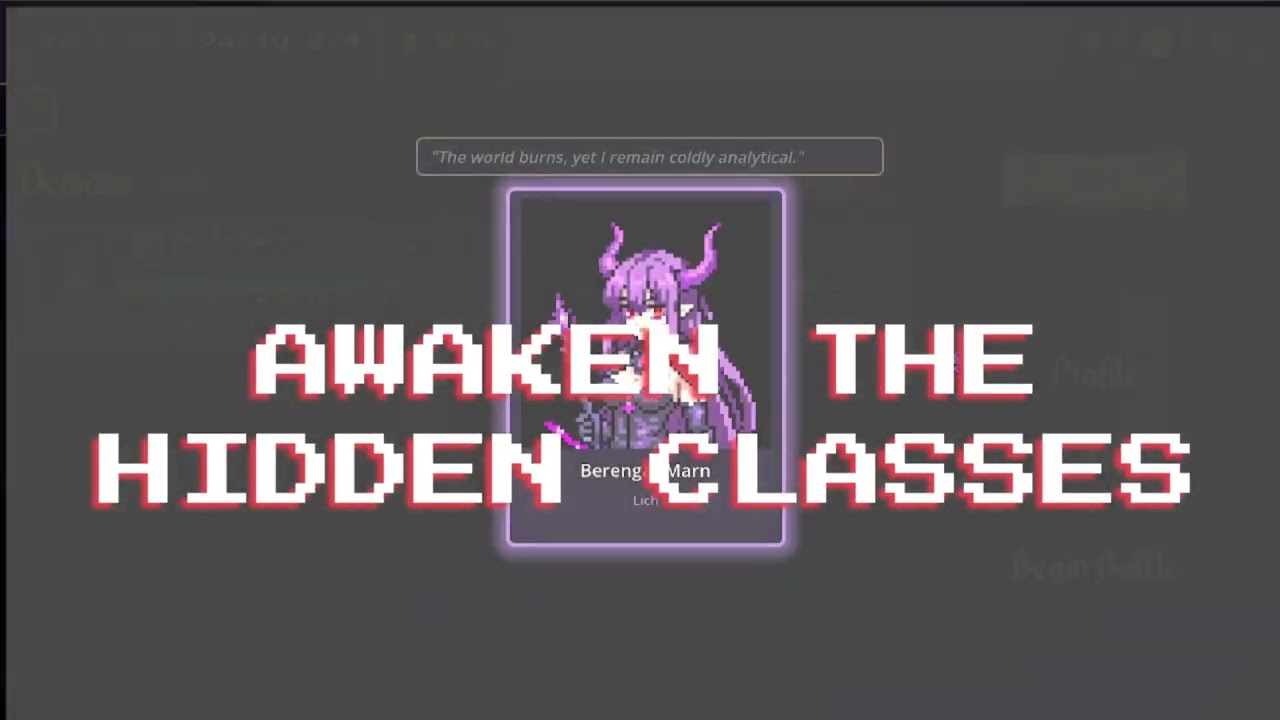
Solo, in Godot 4 / GDScript: a deterministic combat simulator with a separate
visual replay layer; 9 classes with branching talent trees, fusion, relics and
traits; a full roguelike run structure; a complete pixel-art interface; and the
system this case study is about — an LLM-driven council and a cast of living
minions. Everything below is about that last part: the AI-product-design work.
The Hard Problem — Designing On Top Of An Unreliable Co-Author
The castle's standout system is the Round Table Council. Your officers debate a
proposal, and you answer them by typing whatever you want. It runs on a
local language model. Talking to a model is easy; shipping a product on
one is not.
A language model is a co-author you can't fully trust. It is non-deterministic,
sometimes slow, occasionally wrong, and every so often returns output in the
wrong format entirely. A game cannot answer that with a spinner that never ends
or an error on screen. So the core question was never "what prompt?" — it was:
how do you build a reliable, legible experience on top of an unreliable
component? That question shaped every decision below.
Fallback-First — Design The Failure Path Before The Happy Path
I designed the degraded experience first, then built the ideal one on top of it.
Four rules:
- Bound the latency. The game waits a fixed budget (~8 seconds) for the
model. Past that, it stops waiting — no interaction is ever held hostage to the
model's mood.
- Always keep a deterministic fallback. A keyword-based intent classifier
sits underneath the LLM at all times. If the model is slow, offline, or returns
garbage, the keyword layer resolves the player's decision and the council still
concludes — correctly.
- Skip the model when you don't need it. If the player's words clearly
contain "approved" or "denied", I classify locally and never call the LLM at
all — faster, and it sidesteps a real failure mode where a small local model
misreads a plain "Approved" as a question.
- Never block the loop. The model runs asynchronously; the UI polls for a
result. The player sees an honest, in-fiction "the officers are composing…"
state — never a frozen screen.
The governing principle: the AI is an enhancement layer, not a dependency.
Strip the model out entirely and the game is still fully playable. Designing to
that bar is what made an AI-native feature genuinely shippable.
Designing For Open-Ended Input
Letting players type free text into a council is a UX trap — people don't know
what's allowed, and an open box invites inputs the system can't honour. I
designed around that instead of restricting it:
- One intent model, five outcomes. Any input — eloquent or a single word
— is mapped onto five intents: agree, refuse, modify, counter, or stay silent.
The player keeps full expressive freedom; the system gets a bounded space it
can actually act in.
- Teach the space with affordances. The input field always shows live
examples ("Try: Approved, Denied, Too rash—table it…"). Players learn what's
possible by reading the UI, never a manual.
- Make the AI's decision legible. A "herald" character translates the
model's classification back to the player, in fiction — "The Lord's 'why'
suggests he wants the proposal clarified." A hidden ML decision becomes
readable, diegetic feedback; the player always knows what the system heard and
why it responded the way it did.
- Treat "no decision" as a designed state. Asking a question — the
"counter" path — doesn't break the flow or read as an error. It loops back: the
officer answers, and the player speaks again. Hesitation is a valid move, not a
dead end.
The Trade-offs
- Local model vs. cloud API. I chose a local LLM: zero per-player cost,
works offline, no player data leaves the machine. The price is lower quality,
higher and less predictable latency, and no guarantee the player has a strong
GPU. Every fallback above exists because of this trade.
- Determinism vs. emergence. Combat is fully deterministic —
reproducible and balance-safe. The council is deliberately the opposite. I
quarantined the non-determinism to the one system where surprise is the point,
and kept it out of everything where fairness matters.
- Freedom vs. legibility. Free text is expressive but opaque; menus are
legible but flat. I kept the free text and bought the legibility back with the
herald and the on-screen examples — so freedom didn't cost comprehension.
- Depth vs. scope. Solo, finite time. When a whole subsystem (an entire
shop economy) was costing the core loop more than it gave back, I cut it.
Scoping by subtraction kept the game coherent.
Before & After — How It Evolved
None of this was right the first time. The shippable version is the iterated
one:
- The freeze. First: the council awaited the model with no
timeout — on a slow machine the game locked up for 45+ seconds. Now: a
bounded wait plus the keyword fallback; worst case is a few seconds, and it
always resolves.
- The dead end. First: the council only understood a literal
"yes" or "no"; anything else stalled the screen. Now: the full
five-intent model plus herald feedback — the player can argue, hedge, or ask a
question, and the scene always moves forward.
- The invisible deadlock. First: a follow-up dialog rendered
behind the council panel — invisible, yet it still captured every
click, so the whole screen silently stopped responding. Now: fixed
layering. The lesson stuck: around AI interactions, the interaction
plumbing fails just as hard as the model — and far more quietly.
- The economy. First: early numbers made the AI-driven events
trivial to spam. Now: retuned costs and gated low-value events, so
each one stays a real decision.
Working Under Real Constraints
One developer, limited time, and a hard ceiling: the AI has to run on a normal
player's PC — not a server I control. That ruled out "just call a big cloud
model" and forced the discipline above — design the fallback first, treat the
model as optional, quarantine the non-determinism, and turn every failure mode
into a designed experience instead of a bug.
What made an AI-native feature shippable wasn't a better model — it was product
design around an imperfect one. That approach generalises to any product
with an LLM in the loop: assume it will sometimes be slow, wrong, or offline, and
design so the user never pays for it.
What I Took Away
AI product design isn't prompt-writing. It's designing the system around
a probabilistic component so the end user still gets something reliable and
legible: bounded latency, an honest fallback, in-product feedback that explains
what the AI did, and clear, deliberate trade-offs between the AI path and the
deterministic one. Demon Rising is where I learned to actually build that — and
it is the lens I bring to every AI product after it.
 ▶
▶ WATCH THE TRAILER
Opens the trailer on YouTube in a new tab.
▶
▶ WATCH THE TRAILER
Opens the trailer on YouTube in a new tab.